
Grain Mycotoxin Tests
Ensure the safety and quality of your grains and cereals with grain mycotoxin tests from Calibre Control. Our on-site testing solutions help you identify contamination, protect animal and human health, and safeguard product value.
Mycotoxin contamination in grains and animal feed poses serious risks to public health and agricultural productivity. Testing is an essential part of production, often required by legislation and consumer assurance schemes.
Calibre Control’s grain mycotoxin tests detect key toxins with speed and precision. Our easy-to-use lateral flow tests and reader systems are backed by expert technical support, giving grain handlers and food manufacturers confidence in product quality and compliance with international standards.
For more detail on our grain mycotoxin tests, please contact our team by emailing info@calibrecontrol.com.

Charm ROSA Lateral Flow Test Strips
Using ROSA technology, these simple lateral flow test strips provide quantitative results in just a few minutes. A range of strips is available for key mycotoxins including aflatoxin, DON, ochratoxin, fumonisin, zearalenone and T‑2/HT‑2. Their colour-coded format means they can all be read on the same Charm EZ-M reader.
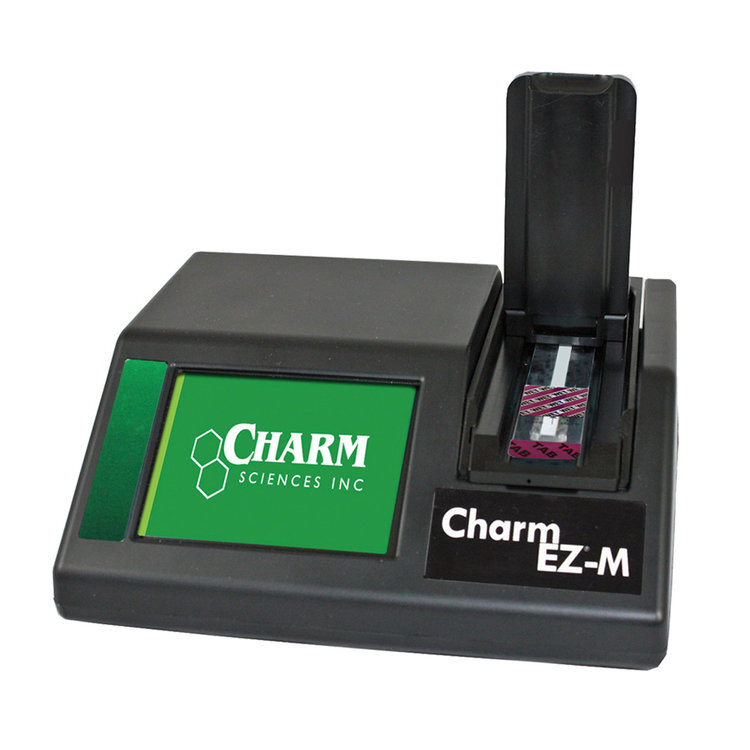
Charm EZ-M Mycotoxin Reader
The EZ-M Reader is a fully automated system combining incubator and reader in one compact instrument. Once the test strip is inserted, the reader identifies the test, incubates it for the correct time and analyses it automatically, before securely storing the data for export to other devices and formats.
Charm Mycotoxin testing solutions are FGIS approved for a wide range of feed and grain commodities, offering additional assurance over method performance and suitability for trade.
What Are Grain Mycotoxin Tests?
Mycotoxins are naturally occurring toxic metabolites produced by certain moulds that can grow on grains and cereals. Contamination can occur at any stage of crop growth, harvesting, drying or storage, influenced by factors such as temperature, humidity, kernel damage, insect activity, mishandling and environmental stress.
Because mycotoxins are invisible and odourless, it’s impossible to detect them through visual inspection alone.
Grain mycotoxin tests provide on-site analysis of commodities such as wheat, corn, barley, seeds, maize, oats and other cereals using rapid lateral flow test strips and a dedicated reader. Together, they determine the presence and quantity of key mycotoxins including aflatoxin, ochratoxin, fumonisin, DON, zearalenone and T-2/HT-2 toxins. With a clear result in minutes, you can make informed decisions about accepting, segregating or rejecting grain, safeguarding public health and the integrity of the food and feed chain.
Why Mycotoxin Testing Is Essential for Grain Producers and Processors
Testing for these harmful toxins is essential for several reasons:
• Protecting human and animal health — Mycotoxins can cause serious health problems, including liver and kidney damage, gastrointestinal issues, immune suppression and cancer. Livestock consuming contaminated feed may pass mycotoxin residues into milk, meat or eggs, extending the risk to humans via the wider food chain.
• Regulatory compliance — Mycotoxins in food and animal feed are subject to strict limits in the UK, EU and other markets. Routine testing helps you demonstrate that your cereals and grains meet these legal thresholds.
• Avoiding costly rejections and recalls — Undetected mycotoxin contamination can lead to rejected loads, downgraded contracts, recalls and potential legal penalties. Screening cereals and grains throughout production reduces the risk of expensive disruptions and protects your reputation.
• Market access and customer confidence — Routine grain mycotoxin testing provides objective data to share with buyers, supports assurance schemes, and helps you retain access to high-value markets.
How Grain Mycotoxin Testing Works
Because mycotoxins in grains and cereals cannot be identified by visual inspection alone, it’s important to take a systematic approach to grain mycotoxin tests. With the right equipment, routine mycotoxin testing is quick, straightforward and reliable.
Mycotoxin contamination is often unevenly distributed throughout a batch, so samples should be collected from multiple points and combined into a composite sample. When preparing that sample, using a purpose-built laboratory mill helps achieve a consistent particle size and improves the reliability of your results.
For routine on-site testing, Calibre Control uses rapid lateral flow grain mycotoxin tests from Charm Sciences. As the world leader in mycotoxin testing, Charm Sciences is trusted globally for the accuracy and reliability of its rapid test systems. Charm’s ROSA (Rapid One Step Assay) strips cover a range of mycotoxins. The test workflow is simple. Mix the ground grain with water, apply the extract to the strip, and place it in the dedicated reader. The reader recognises the test, applies the correct incubation time, temperature and calibration, and reports a quantitative result in real time.
Laboratory reference methods such as HPLC or LC-MS remain important for confirmatory analysis and complex multi-toxin profiling. Rapid grain mycotoxin tests like the Charm system provide the speed and simplicity required for day-to-day decisions at grain intake and during storage.
Challenges in Grain Mycotoxin Testing
Analysing mycotoxins in grains and cereals presents some specific challenges. Mycotoxins are rarely distributed evenly throughout a batch and may be present at low levels, so the quality of your sampling has a major impact on the reliability of grain mycotoxin tests.
Mycotoxins can occur naturally at various stages of production. Environmental conditions affect the crop before harvest, while storage conditions can also influence mould growth. Deciding where, when and how often to test is a crucial part of your risk management.
Sample preparation and handling are equally important. Using appropriate milling and testing equipment helps ensure consistent particle size and extraction, reducing variability and helping to mitigate these challenges.
Choosing the Right Equipment for Grain Mycotoxin Tests
Choosing the right equipment for grain mycotoxin testing involves balancing speed, accuracy and cost with what works best day-to-day in your operation.
Here are some key points to consider:
· Testing method: Decide whether rapid lateral flow grain mycotoxin tests, lab-based methods, or a combination of both best fit your intake and workflow.
· Regulatory requirements: Check your chosen kit meet UK/EU limits and any standards required by customers or assurance schemes.
· Target mycotoxins: Make sure the system covers the mycotoxins most relevant to your grains and market, e.g. aflatoxin, DON, ochratoxin, zearalenone or T-2/HT-2.
· Accuracy and sensitivity: Look for validated tests with proven performance at concentrations close to your limits so results support confident decisions.
· Speed: Consider how quickly you need results. Short incubation times and immediate results avoids unnecessary delays.
· Ease of use: Choose equipment that’s simple for staff to operate, with clear instructions and automated readers that reduce user error.
· Data management: Systems that store and export results make it easier to demonstrate compliance and respond to audits.
Your Partner in Grain Mycotoxin Control
In addition to supplying grain mycotoxin tests, Calibre Control acts as your testing partner, offering technical support, staff training and helping to design mycotoxin testing solutions that support ongoing compliance. To discuss your requirements or request tailored advice, contact our team on info@calibrecontrol.com.